
Every project shown here represents end-to-end ownership, from strategy and planning through copywriting, design, production, deployment, and reporting.
The Challenge
LEADS WENT QUIET, BUT THEY WEREN’T ALWAYS LOST.
Archived and stagnant leads were often treated as the end of the sales process, even when they still had buying intent. If a lead stopped responding, had no next activity scheduled, or was moved out of the active pipeline, there was not always a consistent way to re-engage them with messaging that matched their original campaign source, funnel stage, or previous behavior.
The goal was to create an automated nurture system that could identify inactive leads, understand their CRM and campaign context, personalize follow-up, track engagement, and signal when a lead was ready to re-enter the sales cycle.
Solution
I BUILT A BEHAVIOR-BASED NURTURE SYSTEM THAT REACTIVATED STAGNANT LEADS USING CRM CONTEXT, AI PERSONALIZATION, AND ENGAGEMENT SCORING.
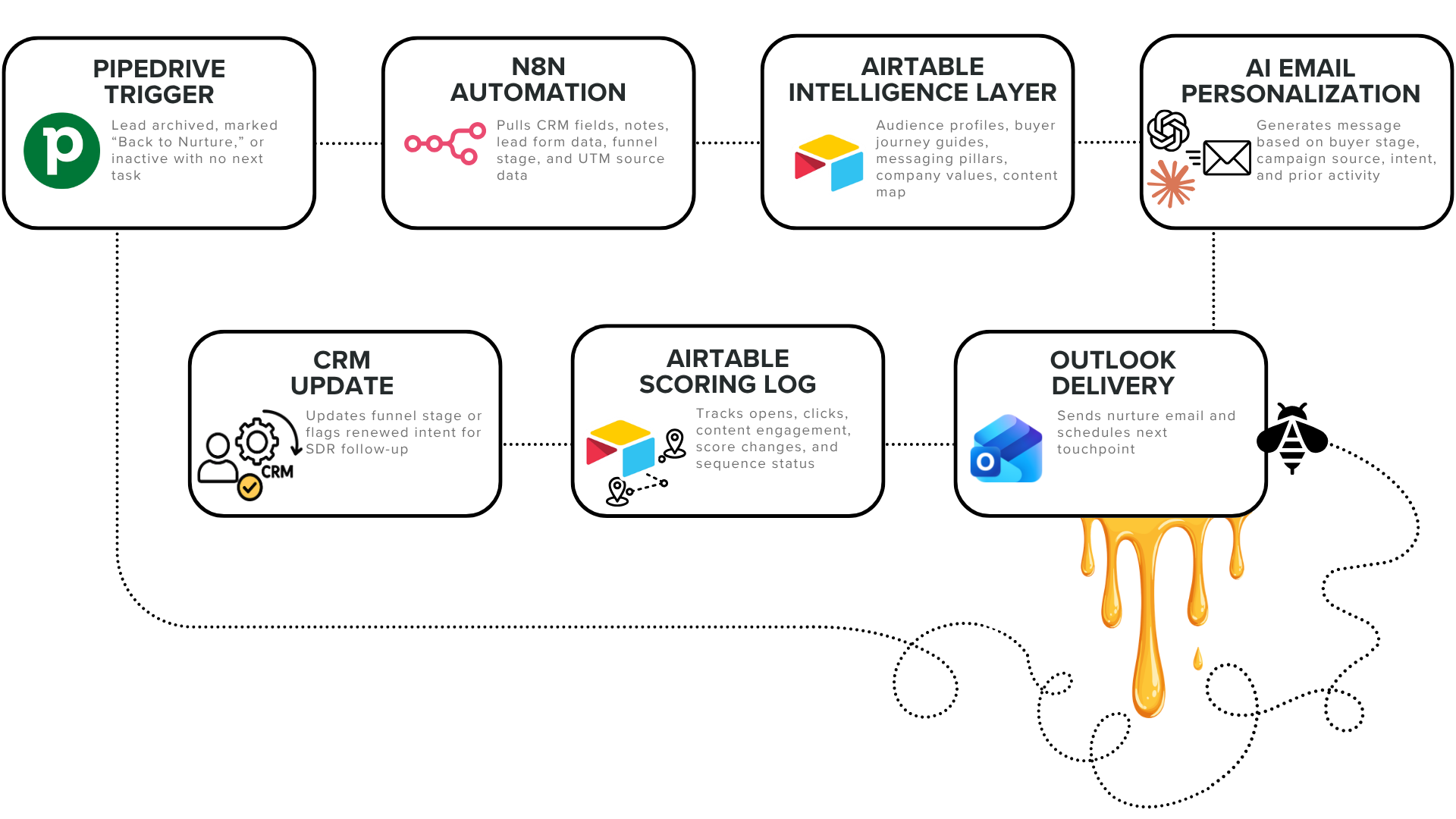
The workflow used Pipedrive as the CRM trigger and n8n as the automation layer. When a lead was archived, manually moved back into nurture, or automatically marked inactive after too many days without a next activity, the automation pulled available CRM data through the API.
That data included lead form information, funnel stage, notes, previous activity, UTM parameters, campaign source, and any enriched context already stored in the CRM. The automation then referenced Airtable as the intelligence layer, where buyer journey guides, audience profiles, messaging pillars, company values, content references, nurture rules, and scoring logs were stored.
AI used that combined context to generate a personalized nurture email, which was sent through Outlook. As the lead engaged with emails or clicked specific content, Airtable logged the activity and updated the score. That score influenced the next email they received and could update the lead’s funnel stage in Pipedrive when behavior showed renewed buying intent.